加拿大最荒诞的巨额盗窃案 ,2700吨 "液体黄金 "不翼而飞 !没想到有人偷这个 ...

铺 子

▲点击进入 相应板块
Unexplained Mysteries

BACKDROP
The Great Canadian Maple Syrup Heist

背景介绍:
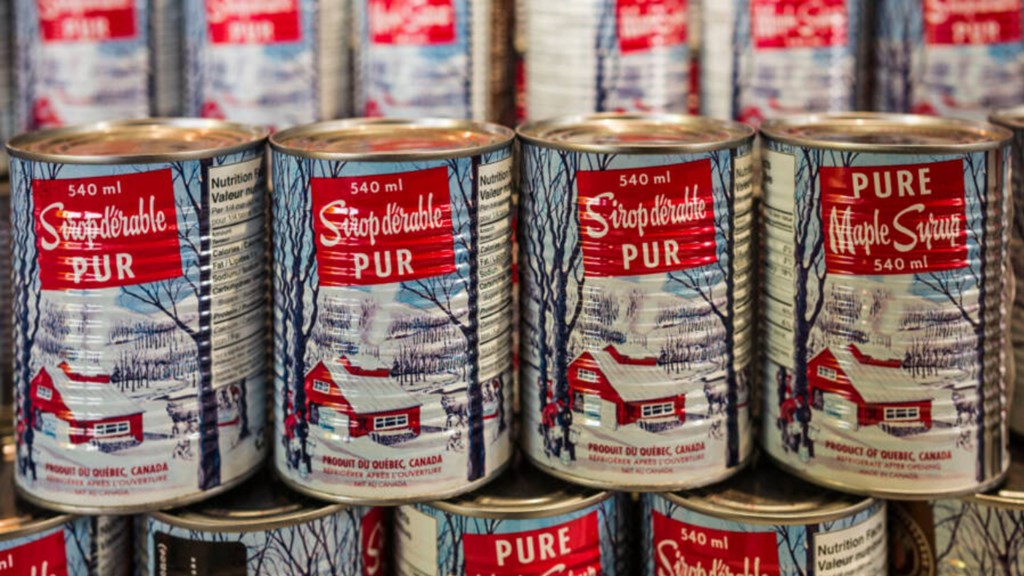
魁北克是全球枫糖浆核心产区,枫糖浆生产受天气制约,产量波动大。魁北克枫糖浆生产商联合会建立国际战略储备库,丰收年储存过剩枫糖浆,歉收年份投放市场,以此稳定全球供给与价格,被比作 “枫糖浆银行”。
2011 年收成很好,联合会租用一处仓库存放约 16000 桶枫糖浆。这座仓库安防薄弱,缺少监控与高级报警系统,仅依靠年度盘点来核对库存。枫糖浆液态无专属识别标记,转手之后很难溯源,具备被大规模盗窃的条件。
事件简介:
2011‑2012 年,犯罪分子利用仓库内租赁的场地,长期悄悄作案。初期抽走糖浆后灌水伪装,后期直接搬走整桶。
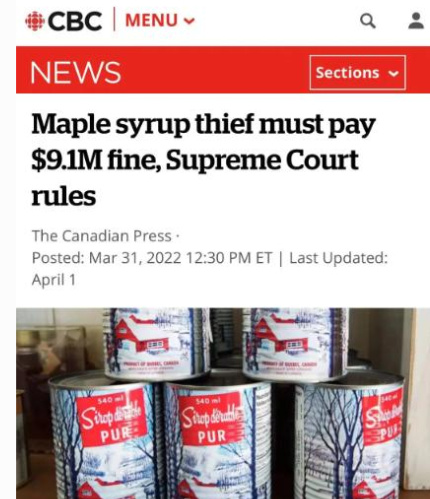
2012 年 7 月会计盘点时踩动空桶,盗窃才败露。总共失窃 9571 桶,约2700吨枫糖浆,市价超 1800 万加元。赃物流向加拿大其他省份与美国。警方顺着交易记录追查,主犯理查德・瓦利耶尔落网,2016 年被判盗窃、诈骗等罪名,获刑 8 年。罚款历经上诉,2022 加拿大最高法院最终恢复 900 多万加元罚金。
此案成为加拿大史上知名的大型食品盗窃案。
Ep/28

MYSTERIES
Unexplained Mysteries
with Anlan
Welcome to a world of secrets and unanswered questions—a world of true mysteries that no one has ever solved. Today, we are going on a journey into the strange and the unexplained.
Are you ready to explore the unknown? Let's begin.

🎵
🔺点击收听音频
Liquid Gold: The Great Canadian Maple Syrup Heist
On the morning of 30 July 2012, accountant Michel Gauvreau entered an enormous red-brick warehouse beside the Trans-Canada Highway in Quebec.
He was there to count barrels.
It should have been a routine job.
Inside the building, thousands of pale-blue metal barrels stood in long rows. They were stacked six barrels high and stretched so far into the warehouse that the ones at the back seemed to disappear into the darkness.
Each barrel was supposed to contain almost three hundred kilograms of pure Canadian maple syrup. Gauvreau began climbing on one of the stacks to check the identification numbers.
Then a barrel moved beneath him.
A full barrel should have been extremely heavy. It should not have moved at all. But this one rocked as Gauvreau placed his weight on it, nearly causing him to fall.
He regained his balance and examined it.
The barrel was empty.
At first, this probably appeared to be a simple mistake. Perhaps one empty barrel had accidentally been included in the inventory.
Then Gauvreau found another.
And another.
The warehouse managers were called. Together, they opened a barrel that appeared to be full. But instead of finding thick, amber-coloured syrup, they discovered a clear liquid with no colour and almost no smell.
It was water.
Someone had stolen the maple syrup and replaced it.
This was the beginning of the investigation into the Great Canadian Maple Syrup Heist—an extraordinary crime involving thousands of barrels, millions of dollars and a black market built around one of Canada’s most famous products.
To understand how maple syrup could become the target of such a huge criminal operation, we first need to understand its value.
Real maple syrup is not simply flavoured sugar water poured onto pancakes.
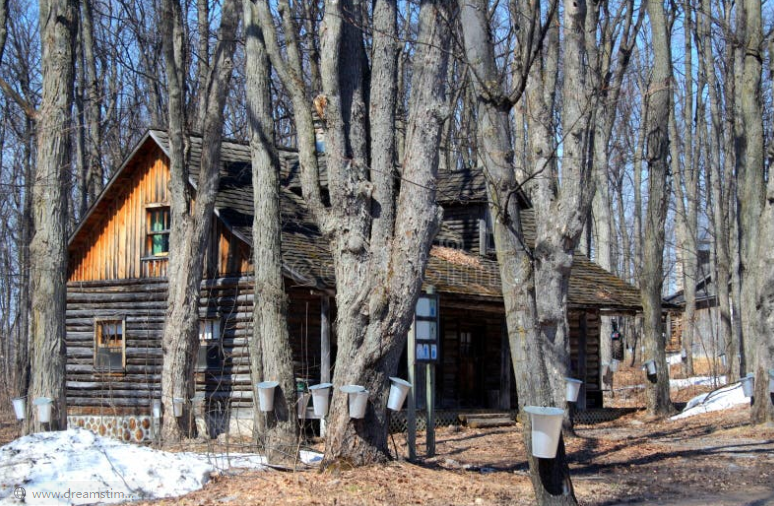
It begins inside maple trees. During a short period in late winter and early spring, freezing nights are followed by warmer days. These changes in temperature cause sap to move through the trees.
Producers collect the sap and transport it through networks of tubes to buildings known as sugar shacks. There, much of the water is removed and the remaining liquid is heated until it becomes concentrated maple syrup.
Producing one litre of syrup can require around forty litres of sap.
The entire annual harvest depends on a few weeks of suitable weather. If spring arrives too early, the season may be short. If conditions are poor, production can fall dramatically.
Quebec is the centre of the global maple syrup industry. At the time of the heist, the province produced most of Canada’s syrup and a large percentage of the world’s supply.
But production was unpredictable.
A successful season could create too much syrup, causing prices to fall. A poor season could create a shortage, sending prices upwards and leaving international customers without enough supply.
The Federation of Quebec Maple Syrup Producers developed a solution: the International Strategic Reserve.
The name makes it sound like a secret government bunker protected by soldiers. In reality, the reserve was operated by an organisation representing Quebec’s syrup producers.
During years of high production, surplus syrup was stored in warehouses. During years of lower production, barrels could be released from the reserve, and this helped maintain a reliable supply and kept prices relatively stable.
It was, in effect, a bank.
But instead of gold bars, its vaults contained maple syrup.
And like gold, syrup was valuable, easy to sell and difficult to identify once it had been removed from its original container.
In 2011, Quebec enjoyed a particularly successful harvest. The Federation needed additional storage and rented a new warehouse, about two hours from Montreal.
Around sixteen thousand barrels were eventually stored there.
The warehouse was large, but security was surprisingly limited. Reports indicate that it had no sophisticated alarm system or network of security cameras. A guard was expected to visit the building, but the barrels themselves were normally checked through an annual inventory.
Someone realised that syrup could disappear slowly without being noticed.
The thieves did not smash through the doors in the middle of the night. There were no dramatic explosions, high-speed escapes or masked figures lowering themselves from the roof.
Instead, the operation continued over a period of months in 2011 and 2012.
Access to the building was the key.
One person connected to the scheme had rented space inside the same warehouse. This meant that trucks and workers could enter without immediately attracting attention. Barrels could be moved across the building and taken out through another loading area.
At first, the thieves appear to have tried to conceal what was happening. Syrup was removed from barrels, and some were refilled with water before being returned to the stacks.
From the outside, the barrels still looked untouched.
Later, as the operation grew bolder, entire barrels were removed or left empty.
The stolen syrup then entered a complicated network of buyers, transporters and distributors. Some of it travelled to other parts of Canada, including New Brunswick and Ontario. Some crossed into the United States.
Much of it was sold in smaller quantities. Once it had been transferred into different barrels and mixed with other supplies, establishing exactly where it came from became extremely difficult.
Some businesses that purchased the syrup may not have known it was stolen.
The size of the operation was astonishing.
By the time investigators completed their calculations, the contents of 9,571 barrels had disappeared. The missing syrup weighed approximately 2.7 million kilograms and had a market value of more than eighteen million Canadian dollars.
Moving that much liquid would have required the equivalent of more than one hundred full tractor-trailer journeys.
This was not someone secretly filling a few bottles and hiding them beneath a coat.
It was an industrial-scale operation.
Yet it remained undiscovered until one unstable barrel moved beneath an accountant’s foot.
After the discovery, police from the Sûreté du Québec began following what journalists soon called the “syrup trail.”
But tracing stolen maple syrup presented an unusual challenge.
A stolen painting can be recognised. A stolen car has a registration number. Gold bars may carry identifying marks.
Syrup does not.
Once poured into another container, one barrel of amber liquid looks much like any other. Investigators had to examine business records, transport information, warehouse equipment, sales figures and export data.
They interviewed hundreds of people connected to the maple syrup industry. They studied scales, forklifts and syrup-processing equipment. They compared the amount of syrup that businesses claimed to have produced with the amount they had actually sold.
The investigation soon led to New Brunswick.
In September 2012, police arrived at a syrup-exporting business in the small community of Kedgwick. Inside its warehouse, they found syrup worth more than a million dollars.
The owner, Étienne St-Pierre, had operated outside Quebec’s tightly controlled syrup system for years. He maintained that provincial marketing rules did not apply to his New Brunswick business.
Investigators began connecting some of his supplies to Richard Vallières, a Quebec syrup dealer who bought and sold barrels outside the Federation’s official network.
Vallières already understood the unofficial syrup market. He knew buyers, transporters and distributors. More importantly, he knew how millions of kilograms of stolen syrup might be transformed into millions of dollars.
Police searched properties, seized barrels and followed financial records. Approximately two-thirds of the stolen syrup was eventually traced to businesses in Canada and the United States, although not all of it could be recovered.
Then, in December 2012, as snow covered the Saint Lawrence Valley, police began making arrests.
The investigation eventually involved numerous suspects, although only some were convicted of offences connected with the heist.
The central figure was Richard Vallières.
During his trial, prosecutors described a carefully organised operation that depended on warehouse access, transport vehicles and a network capable of selling enormous quantities of syrup without attracting too much attention.
In 2016, a jury found Vallières guilty of theft, fraud and trafficking in stolen goods. He was later sentenced to eight years in prison.
But the legal story continued.
Vallières stated that he had sold the syrup for around ten million dollars while personally earning a profit of approximately one million.
The original trial judge ordered him to pay a fine of more than nine million dollars. An appeal court later reduced it to around one million, reasoning that the smaller amount represented his personal profit.
The case then reached the Supreme Court of Canada.
In March 2022, almost ten years after the theft was discovered, the Supreme Court restored the fine of more than nine million dollars. The judges explained that the relevant law considered the value of the criminal property Vallières controlled, not simply the profit he kept for himself.
The message was clear: handling ten million dollars’ worth of stolen syrup could result in a ten-million-dollar problem.
The Great Canadian Maple Syrup Heist has become famous partly because it sounds ridiculous.
Maple syrup is warm, sweet and comforting. It belongs on breakfast tables. It appears in gift shops and tourist advertisements beside pictures of red leaves and snowy forests.
It does not sound like the centre of an international criminal investigation.
But that is exactly why the story is so fascinating.
The thieves recognised that those quiet warehouse shelves held something extremely valuable. They did not need diamonds, paintings or piles of cash.
They had liquid gold.
For months, trucks carried it away while thousands of water-filled and empty barrels waited silently in the darkness.
The entire plan might have continued even longer if Michel Gauvreau had not climbed onto the wrong barrel on that July morning.
One small movement exposed everything.
A metal barrel rocked beneath his feet.
And one of the largest thefts in Canadian history came crashing into view.
排版长图:
责编/校对:
图片来源:
Jer.ry
Jenny
均来源于网络 | 侵删







▲点击以上图片,Get世界精选好物


