《安澜故事 》-天才的双面人生 :因同性恋而被化学阉割 ,死后才被英王室特赦 ...

▷
Tales from History

Tales from History
Alan Turing
△点击播放音频

Tales from History with Anlan
In this segment, I'm going to share with you some of the most exciting, terrible, fascinating and funny stories from history. So, sit back, relax and come with me to a time long, long ago.
Today we're talking about Alan Turing – a brilliant mathematician, a wartime hero, and the father of modern computing. If you've ever wondered how we cracked secret codes in World War II or where the idea of artificial intelligence came from, this episode is for you. We'll keep things exciting, with stories of spies, machines, and big ideas. Let's get started!
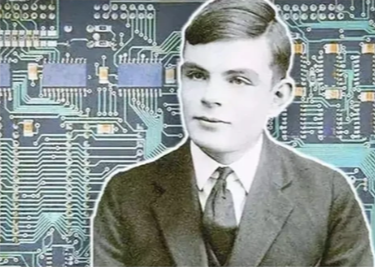
Alan Turing was born in 1912 in London, England. From a young age, he was fascinated by science and puzzles. As a boy, he loved reading books about how things work, like the way plants grow or machines operate. He went to top schools, including Cambridge University, where he studied mathematics. But Turing wasn't just good with numbers – he was a genius at thinking about how to solve impossible problems.
✏ Mathematician 数学家
✏ Crack secret codes 破解密码
✏ Artificial intelligence 人工智能
✏ Fascinated by 被...迷住
In the 1930s, Turing came up with an idea that would change everything: the "Turing Machine." Imagine a simple device that could follow instructions to solve any math problem, step by step. It was like a blueprint for the computers we use today. Turing showed that some problems can't be solved by machines, no matter how smart they are. This was huge for the world of computing, but his biggest challenge was still ahead.
When World War II started in 1939, Britain needed help against Nazi Germany. The Germans used a machine called Enigma to send secret messages. Enigma looked like a typewriter with spinning rotors that scrambled letters in billions of ways.
This was a very very complicated machine. And the settings changed every day, making it seem unbreakable. This code could never be broken, they could never understand the codes that were being sent.
✏ Turing machine 图灵机
✏ Follow instructions 听从指令
✏ Step by step 逐步地
✏ Nazi Germany 纳粹德国
✏ Typewriter 打字机
✏ Rotors 转子
✏ Unbreakable 牢不可破的
German U-boats or submarines in the Atlantic used it to attack Allied ships, sinking supplies, food, weapons, and starving Britain.
Now this was a huge problem, Britain is a very small island. There was not enough food, there were not enough supplies. So, if the ships couldn’t arrive in the UK, then the war was lost.
Turing had already been working part-time for the British Government's Code and Cypher School. On September 4, 1939, the day after Britain declared war, he arrived at Bletchley Park – a big country house turned into a top-secret codebreaking center. It was full of huts where hundreds of clever people, including mathematicians, linguists, and chess players, worked around the clock. Turing led Hut 8, the team focused on cracking the naval Enigma, which was even harder because the navy used more rotors and stricter procedures.
✏ Submarine 潜艇
✏ Allied ships 盟军船只
✏ Starving 使饿死
✏ Codebreaking center 破译中心
✏ Linguists 语言学家
✏ Work around the clock 连轴转地工作
They built on earlier work from Polish codebreakers. In 1932, a Polish mathematician had first broken Enigma using math and patterns in messages. Just before the war in July 1939, the Poles shared their secrets with the British and French, including replica Enigma machines. This gave Turing a head start, but the Germans kept improving it.
The challenge was huge. Each Enigma message started with a "key" – three letters repeated to set the rotors. Now the rotors were turning around in the machine. But with plugboards adding extra swaps, there were trillions of possibilities. Turing's team used "cribs" – educated guesses about what the message might say, like common phrases in weather reports, or they might use the German words for weather reports. Based on the time that they sent the message, they looked for loops in the code where letters connected in chains.
✏ Replica 复制品
✏ Plugboards 插线板
✏ Swaps 字母交换对
✏ Trillions 万亿
✏ Loops 字母链字符环
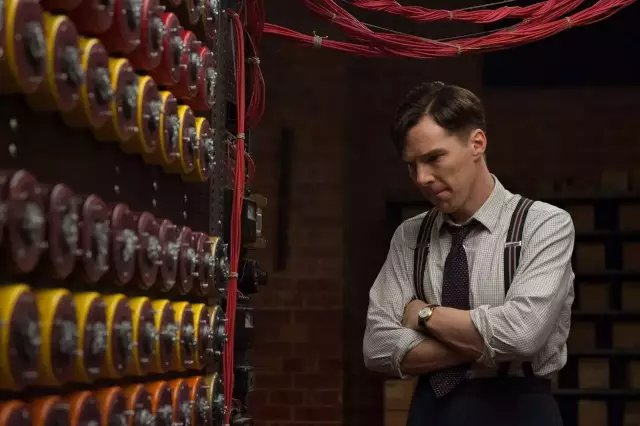
Turing designed a machine called the "Bombe" – not an explosive, but a clever electromechanical device with dozens of spinning drums that mimicked Enigma rotors. They called it "Bombe" because it sounded like a bomb ticking as it went around.
It could test thousands of settings per minute, stopping when it found a match that avoided impossible contradictions, like a letter encrypting to itself. Now this was one fatal flaw in Enigma machine because Enigma would never use the same letter for itself. So that removed lots of possibilites.
His colleague Gordon Welchman added a "diagonal board" that made it even faster and more efficient.
The first Bombe arrived in March 1940, and soon they had over 200 running. One thrilling breakthrough came in May 1940 when they cracked their first naval message. But it wasn't always smooth – in 1942, the Germans added a fourth rotor to naval Enigma, blacking out decryptions for months. Turing and his team, helped by captured codebooks from sunk U-boats like U-110 and U-559, fought back and adapted the Bombes.
✏ Bomb ticking 炸弹滴答声
✏ Encrypting 加密
✏ Fatal flaw 致命缺点
✏ Breakthrough 突破
✏ Decryption 解密
✏ Codebooks 密码本
Working at Bletchley was intense: long hours in cold huts, secrecy that meant no one could ever talk about it, even to family. Turing cycled to work, sometimes wearing a gas mask to fight hay fever! The codebreakers played chess and solved crosswords to stay sharp. Their success, part of the Ultra intelligence program, let the Allies read German plans. It helped win the Battle of the Atlantic by dodging, avoiding U-boats, protecting convoys of ships, and even misled the enemy before D-Day when American, British and Canadian soldiers first started to liberate France in June, 1944.
Sometimes, to protect secret, they even had to let attacks happen on their ships, even though they knew what was happening, because they did not want the Germans to know they had cracked the code.
But historians now say it shortened the war by up to two years, and Alan Turing and his team saved millions of lives. Turing became a hero, but it was all top secret – he couldn't tell anyone! And only a few people knew what Alan Turing had actually done.
✏ Intense 紧张,强度大
✏ Hay fever 枯草热
✏ Stay sharp 保持敏锐
✏ Dodging 躲开,避开
✏ Convoys of ships 舰队
After the war, Turing turned to new frontiers. In 1950, he wrote a famous paper called "Computing Machinery and Intelligence." He asked: "Can machines think?" To explore this, he proposed what we now call the "Turing Test," a way to judge if a machine shows intelligent behavior like a human.
Here's how it works: Imagine a game where a human judge talks to two hidden players through text – one is a real person, and the other is a machine. The judge asks questions and gets answers, but doesn't know who is who. If the machine can fool the judge into thinking it's the human at least 30% of the time (Turing suggested this as a benchmark), then we might say the machine is thinking or showing intelligence.
Turing didn't claim this proved machines have real thoughts or feelings – he was more interested in whether they could imitate human conversation so well that we couldn't tell the difference. He predicted that by the year 2000, computers would pass this test easily. He even discussed objections, like the idea that machines can't be creative or have emotions, but he argued that humans aren't perfect either, and machines could learn from experience. The test has been criticized over the years – some say it's too focused on deception rather than true understanding, and it doesn't test deeper intelligence like problem-solving or empathy. Others point out that modern AI, like chatbots, can pass simple versions but still make silly mistakes. Despite this, the Turing Test sparked huge debates and research in AI, influencing everything from video games to virtual assistants.
This was the birth of artificial intelligence, or AI. Turing dreamed of computers that could learn and create, like composing music or playing chess. He even built one of the first computers, called the Manchester Mark 1, and programmed it to make musical notes. Today, AI is everywhere – in your phone's voice assistant or self-driving cars, and AI modes such as ChatGpt have actually passed the Turing test. And it all started with Turing's bold questions.
✏ Benchmark 基准线
✏ Deception 欺骗
✏ Empathy 共情
✏ Debates 辩论
✏ Composing music 作曲
✏ Voice assistant 语音助手
But Turing's life wasn't all triumphs. He faced personal struggles. In 1952, he was arrested for being gay, which was illegal in Britain back then. He lost his security clearance and suffered harsh treatment, including chemical castration, which meant that he could no longer have sexual feelings. Sadly, in 1954, Turing died at age 41, likely by suicide. It was a tragic end for such a brilliant mind.
In 2009, the British government apologized, and in 2013, Queen Elizabeth II pardoned him saying that he did not commit a crime. Now he's celebrated worldwide, with awards and films in his honor.
So, what can we learn from Alan Turing? He showed us that curiosity, logic, and teamwork can crack the toughest codes and spark new worlds like AI. Next time you use a computer or ask Siri a question, think of him.
And join me next time for more amazing stories. Bye for now!
✏ Triumphs 人生高光,成功时刻
✏ Be arrested 被逮捕
✏ Security clearance 涉密安全许可
✏ Harsh treatment 严厉对待
✏ Chemical castration 化学阉割
历史最终还给他清白,但代价是一个无可替代的头脑和灵魂的过早熄灭。
图灵的一生,是一道比恩尼格玛更深奥的谜题:一个用纯粹逻辑对抗国家敌人的头脑,为何陨落在对抗社会荒谬法律的路上?
也欢迎留言区跟我们分享你的感受,或者你想听的Tales from History.
排版长图:
责编/校对:
图片来源:
Jer.ry
Jenny
均来源于网络 | 侵删








▲点击以上图片,Get世界精选好物


